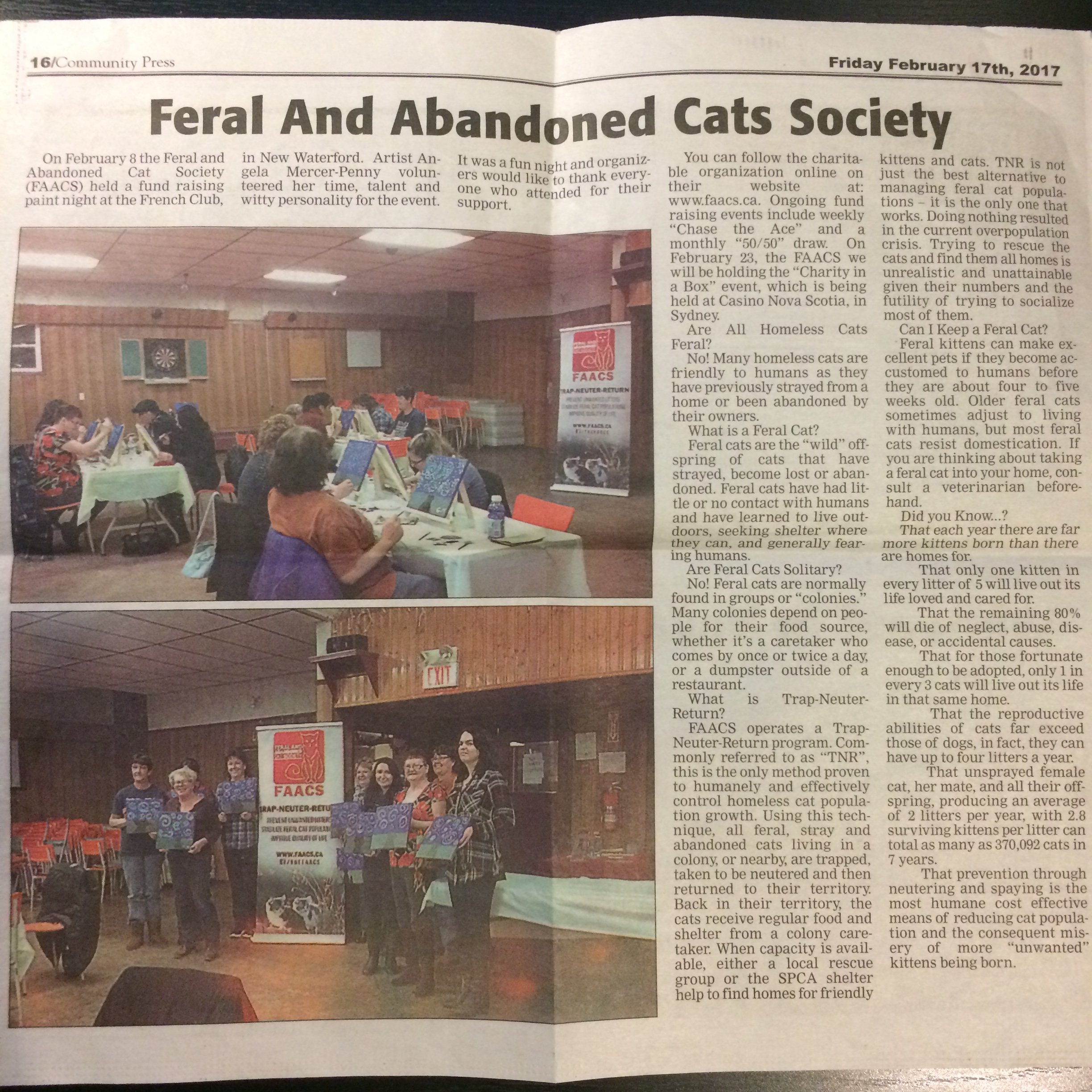
On February 8 the Feral and Abandoned Cat Society (FAACS) held a fund raising paint night at the French Club in New Waterford. Artist Angela Mercer-Penny volunteered her time, talent and witty personality for the event. It was a fun night and organizers would like to thank everyone who attended for their support.
You can follow the charitable organization online on their website at: www.faacs.ca. Ongoing fund raising events include weekly "Chase the Ace" and a monthly "50/50" draw. On February 23, the FAACS we will be holding the "Charity in a Box" event, which is being held at Casino Nova Scotia, in Sydney.
Are All Homeless Cats Feral?
No! Many homeless cats are friendly to humans as they have previously strayed from a home or been abandoned by their owners.
What is a Feral Cat?
Feral cats are the "wild" offspring of cats that have strayed, become lost or abandoned. Feral cats have had little or no contact with humans and have learned to live outdoors, seeking shelter where they can, and generally fearing humans.
Are Feral Cats Solitary?
No! Feral cats are normally found in groups or "colonies." Many colonies depend on people for their food source, whether it's a caretaker who comes by once or twice a day, or a dumpster outside of a restaurant.
What is Trap-Neuter-Return?
FAACS operates a Trap-Neuter-Return program. Commonly referred to as "TNR", this is the only method proven to humanely and effectively control homeless cat population growth. Using this technique, all feral, stray and abandoned cats living in a colony, or nearby, are trapped, taken to be neutered and then returned to their territory. Back in their territory, the cats receive regular food and shelter from a colony caretaker. When capacity is available, either a local rescue group or the SPCA shelter help to find homes for friendly kittens and cats. TNR is not just the best alternative to managing feral cat populations — it is the only one that works. Doing nothing resulted in the current overpopulation crisis. Trying to rescue the cats and find them all homes is unrealistic and unattainable given their numbers and the futility of trying to socialize most of them.
Can I Keep a Feral Cat?
Feral kittens can make excellent pets if they become accustomed to humans before they are about four to five weeks old. Older feral cats sometimes adjust to living with humans, but most feral cats resist domestication. If you are thinking about taking a feral cat into your home, consult a veterinarian beforehand.
Did you Know...?
That each year there are far more kittens born than there are homes for.
That only one kitten in every litter of 5 will live out its life loved and cared for.
That the remaining 80% will die of neglect, abuse, disease, or accidental causes.
That for those fortunate enough to be adopted, only 1 in every 3 cats will live out its life in that same home.
That the reproductive abilities of cats far exceed those of dogs, in fact, they can have up to four litters a year.
That unspayed female cat, her mate, and all their offspring, producing an average of 2 litters per year, with 2.8 surviving kittens per litter can total as many as 370,092 cats in 7 years.
That prevention through neutering and spaying is the most humane cost effective means of reducing cat population and the consequent misery of more "unwanted" kittens being born.